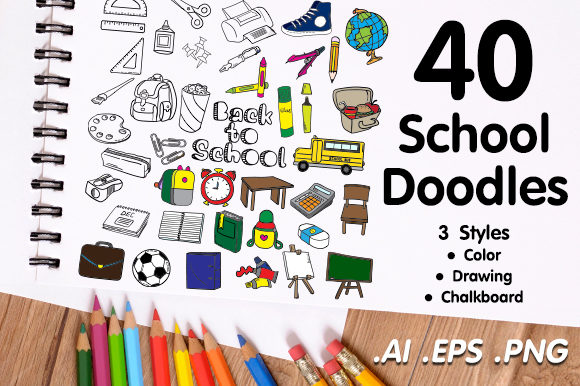
Back to School Doodle Art: A Strategic Tool for Clarity, Planning, and Audience Connection
At first glance, Back to School Doodle Art might appear to be a whimsical or nostalgic creative exercise—a collection of playful sketches featuring pencils, apples, globes, backpacks, and chalkboards. But for professionals, entrepreneurs, and creators who understand that communication and planning are rarely linear, these drawings represent something far more deliberate. They are a visual language that can anchor strategic thinking, clarify complex ideas, and build genuine rapport with audiences who value both substance and approachability.
This is not about decorating a page for the sake of decoration. It is about choosing a medium that inherently lowers barriers to understanding. When used with intention, Back to School Doodle Art becomes a method for translating abstract goals into concrete visuals, for framing new initiatives in a context that feels familiar, and for signaling to your audience that you prioritize clarity over complexity.
What Back to School Doodle Art Really Is and Why It Deserves Your Attention
Back to School Doodle Art refers to the practice of using simple, hand-drawn or digitally sketched illustrations that evoke the school environment—books, rulers, graduation caps, classroom scenes, and study tools—as a communication or planning device. Unlike polished infographics or stock photography, doodle art carries an inherent sense of process and imperfection. It looks like a thought in progress, which is precisely its strategic value.
In a professional context, this style signals that the creator is willing to meet the audience where they are. A sketched diagram of a workflow or a hand-drawn calendar for a project timeline removes the intimidating polish of a formal presentation and replaces it with something that feels collaborative. For decision-makers, marketers, and educators, this can be the difference between an audience passively consuming information and actively engaging with it.
The strategic relevance lies in its universality. School-related imagery is culturally familiar across generations. It evokes a time of learning, growth, and structured progress—associations that align naturally with business planning, skill development, and goal achievement. By tapping into this shared visual vocabulary, you anchor your message in a context that requires no explanation.
Using Doodle Art to Sharpen Your Planning and Goal Setting
One of the most underutilized applications of Back to School Doodle Art is in the early stages of planning. When you are mapping out a quarterly strategy, designing a curriculum, or structuring a marketing campaign, words alone can sometimes obscure rather than reveal. A rough sketch of a learning path or a visual roadmap of milestones can surface dependencies and gaps that text might hide.
Consider a scenario where you are preparing a professional development program for your team. Instead of distributing a dense document outlining learning objectives, you could create a simple visual progression: a doodle of a student walking up steps made of books, each step labeled with a skill milestone. This not only clarifies the sequence but also communicates the philosophy that growth is incremental and achievable. The doodle becomes a reference point that team members can internalize at a glance.
For entrepreneurs and small business owners, doodle art can function as a low-fidelity prototyping tool. When testing a new customer journey or workshop flow, sketch it out as a school-style storyboard. The act of drawing forces you to simplify each stage to its core elements, which often reveals whether the logic holds. If you cannot doodle a process clearly, it is likely not clear enough to execute.
Practical Steps for Integrating Doodle Art into Strategic Planning
- Start with a core question. What single concept or process needs the most clarification in your current project? That is your subject.
- Limit each doodle to one idea. A sketch of a single backpack with compartments labeled for budget, timeline, and deliverables is more actionable than a crowded scene.
- Use school metaphors intentionally. A test paper can represent evaluation, a ruler can denote measurement, and a lunchbox can symbolize resource allocation. Choose imagery that maps directly to your business logic.
- Iterate in a notebook. The strategic value lies not in the final drawing but in the cognitive process of deciding what to represent and how.
Strengthening Brand Positioning and Audience Communication
In a crowded marketplace, how you communicate can be as important as what you communicate. Back to School Doodle Art offers a distinctive visual tone that sets your brand apart from the sea of polished corporate imagery. It signals approachability, creativity, and a willingness to engage on human terms. For audiences aged 20 to 50—many of whom are parents, mentors, or lifelong learners—this evokes a sense of genuine connection rather than transactional messaging.
Marketers can use doodle-style illustrations in email campaigns, landing pages, or social media content to frame product launches as learning journeys. A back-to-school theme works naturally for September campaigns, but the visual language can be adapted year-round. A software company, for instance, might explain a feature update as a "lesson" in a series, using doodled chalkboard diagrams to walk users through the new functionality. The format encourages slower, more thoughtful reading rather than skimming.
Publishers and content creators can integrate doodle art into guides, workbooks, or lead magnets. A downloadable "Back to School Planning Kit" featuring doodle-style templates not only provides practical value but also reinforces a brand that values education and clarity. The key is consistency: if your brand voice is warm and instructive, doodle art amplifies that voice. If your brand is highly formal or technical, consider using doodle art only in internal planning contexts to avoid mixed signals.
Audience Considerations Before Adopting Doodle Art
Not every audience responds to hand-drawn visuals. While Back to School Doodle Art tends to resonate well with professionals in creative industries, education, training, and small business, it may feel out of place in highly regulated sectors like finance or healthcare unless used in carefully controlled internal settings. Before investing time in a doodle-based campaign, test a single piece with a small segment of your audience. Measure engagement through click-throughs, time on page, or direct feedback. The goal is to confirm that the style enhances rather than distracts from your message.
Enhancing Creativity, Productivity, and Learning Through Visual Practice
Beyond external communication, Back to School Doodle Art can function as a personal productivity tool. Sketching ideas is a form of active thinking. When you draw a concept, you engage multiple cognitive pathways—visual, spatial, kinesthetic—that are often underutilized in text-heavy workflows. For freelancers and creators managing complex projects, a doodled workflow can reduce cognitive load and make progress feel tangible.
Educators and trainers can use doodle art to design learning materials that are easier to remember. A hand-drawn diagram of a business model or a sketched timeline of a product lifecycle invites learners to slow down and process each element. The irregularity of the sketch signals that the information is still being worked on, which can encourage questions and discussion. This is especially valuable in workshops or webinars where the goal is collaboration rather than one-way instruction.
For operations and logistics, a doodled map of a customer experience or supply chain can quickly communicate bottlenecks or handoff points without needing a detailed spreadsheet. The simplicity of the drawing forces you to strip away unnecessary detail, revealing the essential flow that drives results.
Risks of Using Doodle Art Without Clear Goals
As with any creative choice, Back to School Doodle Art carries risks when used without strategic context. The most common pitfall is treating it as decoration rather than communication. A page filled with cute but irrelevant sketches does not advance understanding; it creates noise. If your audience cannot immediately grasp the connection between the doodle and the message, the visual becomes a distraction.
Another risk is inconsistency. If you use doodle art in one campaign but revert to polished photography in the next without a clear rationale, your brand identity may feel fragmented. Audiences notice shifts in tone, and inconsistency erodes trust. Decide upfront whether doodle art is a core part of your visual identity or a tactical choice for specific projects. Honor that decision consistently.
There is also a subtle risk of underestimating your audience. Some decision-makers may perceive hand-drawn visuals as unprofessional if they are accustomed to high-production content. This does not mean you should avoid doodle art; it means you should contextualize it. Explain, even briefly, that the visual is a strategic choice for clarity. Honesty about your methods often strengthens credibility rather than weakening it.
Approaching Back to School Doodle Art Intentionally
The most effective use of this style comes from asking a simple question before you draw: Does this image help my audience understand something faster or remember it longer? If the answer is no, the doodle may be better left in the notebook. If the answer is yes, commit to the style fully. Use consistent line weights, a coherent color palette, and a clear visual hierarchy so that the reader knows where to look first and what to take away.
For long-term value, consider creating a library of reusable doodle elements that align with your business vocabulary. A set of icons for common concepts—goals, review, growth, collaboration—can be adapted across presentations, documents, and digital content over months or years. This not only saves time but builds a visual shorthand that your audience will come to recognize and associate with your brand.
Finally, remember that Back to School Doodle Art is a tool, not a strategy. It works best when it serves a larger plan that is already well-defined. Use it to clarify, to connect, and to communicate with warmth and precision. When you approach it as a thoughtful professional rather than a casual doodler, the results speak for themselves: better understanding, stronger engagement, and decisions rooted in clear thinking.